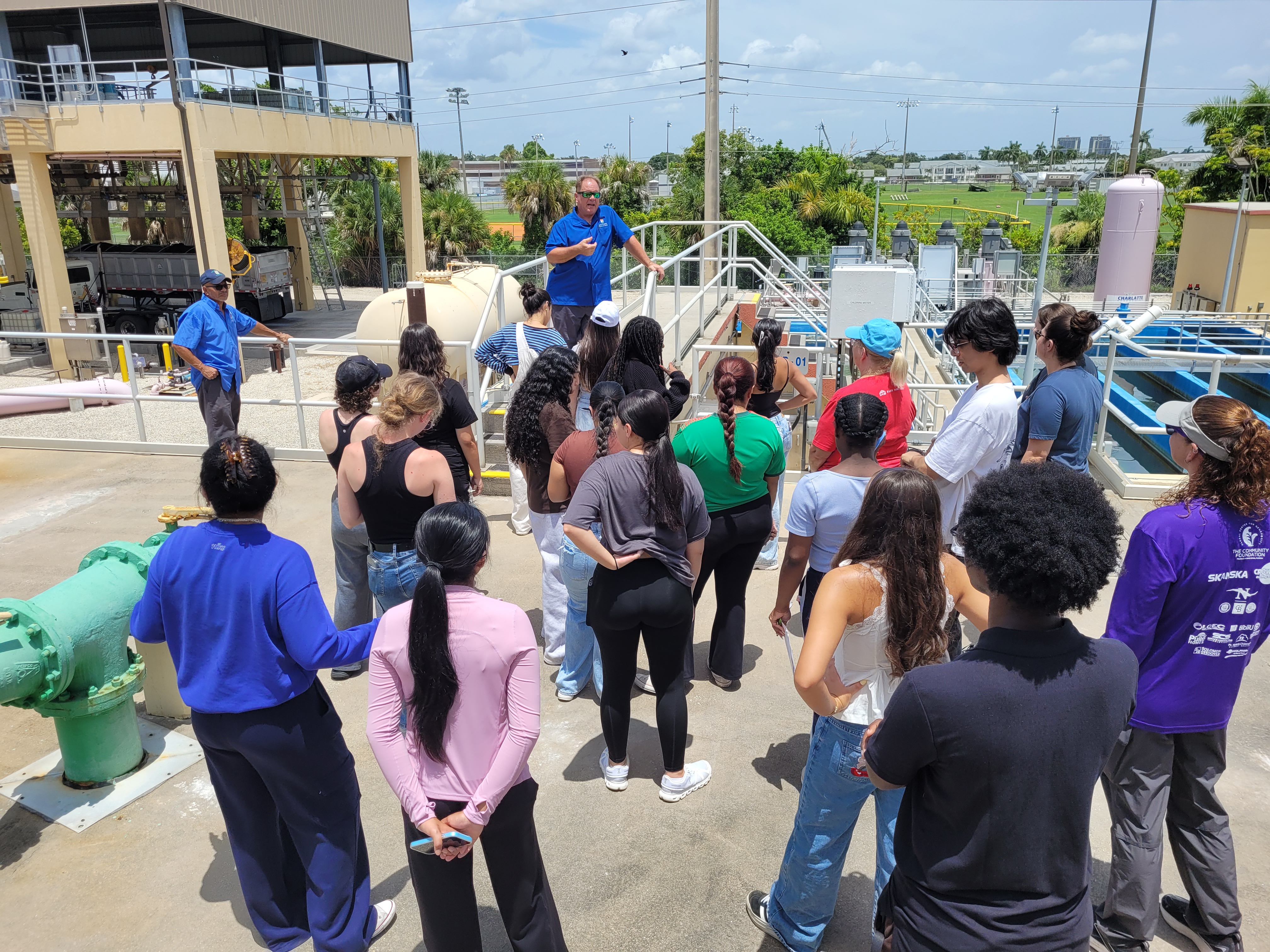
Photo Caption: Microbiology students visit the Fiesta Village Advanced Wastewater Treatment Plant in Fort Myers.
Every day, billions of microorganisms quietly protect public health. Hidden from view, they help clean wastewater, safeguard drinking water and preserve the environment — yet few people ever see them at work. For students in Florida SouthWestern State College’s microbiology course, a visit to the Fiesta Village Advanced Wastewater Treatment Plant in Fort Myers transformed those microscopic organisms from textbook illustrations into an essential part of the infrastructure that keeps communities healthy. “Field experiences like today’s visit to a wastewater treatment plant can transform students’ lives by helping them see that what they are learning has a direct connection to their health, their environment and the well-being of their community,” said Amanda Zirzow, professor of biological sciences at FSW. Students observed how beneficial bacteria and other microorganisms break down organic waste, remove contaminants and improve water quality before treated water is safely returned to the environment. The group saw firsthand how microbiology supports essential public services while protecting Southwest Florida’s natural resources. “This field trip really helped me understand the process of how water is cleaned and how anaerobic and aerobic bacteria function,” said freshman Hadley Rodway. “It was really interesting to learn how bacteria clean wastewater and break down nutrients. The trip gave me a broader understanding of the role of bacteria and how water management works.” While microbiology is often associated with disease-causing organisms, the visit highlighted another side of the discipline by showing how beneficial microorganisms make modern wastewater treatment possible and help protect environmental and public health. “The timing is especially relevant given the current attention surrounding Cyclospora cayetanensis,” Zirzow said. “While the organism is typically associated with foodborne outbreaks rather than wastewater treatment facilities, the discussion helped students connect current events to broader concepts involving sanitation, water quality, disease transmission and public health.” Freshman Sarah Bridgeman said the experience changed the way she views the microorganisms she studies in the laboratory. “This trip showed me a real-world example of the bacteria we see in the lab and how those bacteria help filter materials from the water,” Bridgeman said. “It was also great to see how these processes help conserve water and manage water responsibly.” The experience also introduced students to career opportunities in one of the region’s most vital public utilities. Wastewater treatment depends on professionals across STEM disciplines, including microbiologists, chemists, environmental scientists, laboratory technicians, engineers, instrumentation specialists and plant operators. “When students see microbiology being used to solve real-world problems, the science becomes more than course content; it can spark curiosity, build a sense of purpose and open their eyes to careers and opportunities they may never have considered,” Zirzow said. Lee County Assistant Lead Operator Eugene McCartney reinforced that message during the visit. “The biggest takeaway we’d like students to have is that this plant isn’t just a place where wastewater is processed,” McCartney said. “It’s a biological system — a living, breathing facility — and we manage and accelerate natural processes so we don’t have to rely on harsh chemicals.” Through experiences like this, Florida SouthWestern provides students with an accessible pathway into high-demand careers while helping them connect scientific concepts with meaningful work that strengthens public health and environmental stewardship. For many students, the tour demonstrated that the microorganisms they study in the laboratory play a vital role in protecting communities every day.