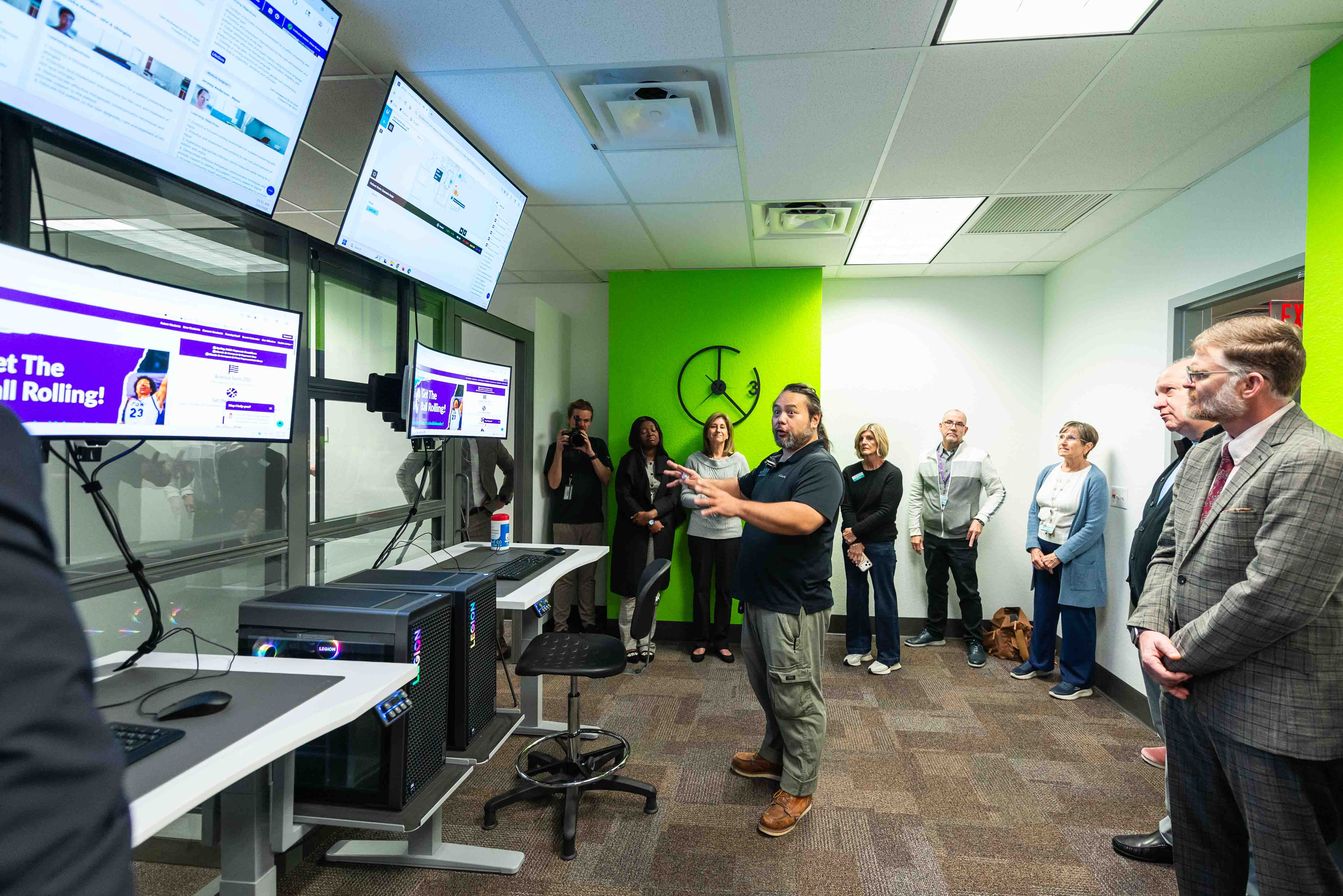
Top Left: Mon Navarro, IIET program support specialist, gives an overview of the XR Suite technology to guests at the IIET grand opening.
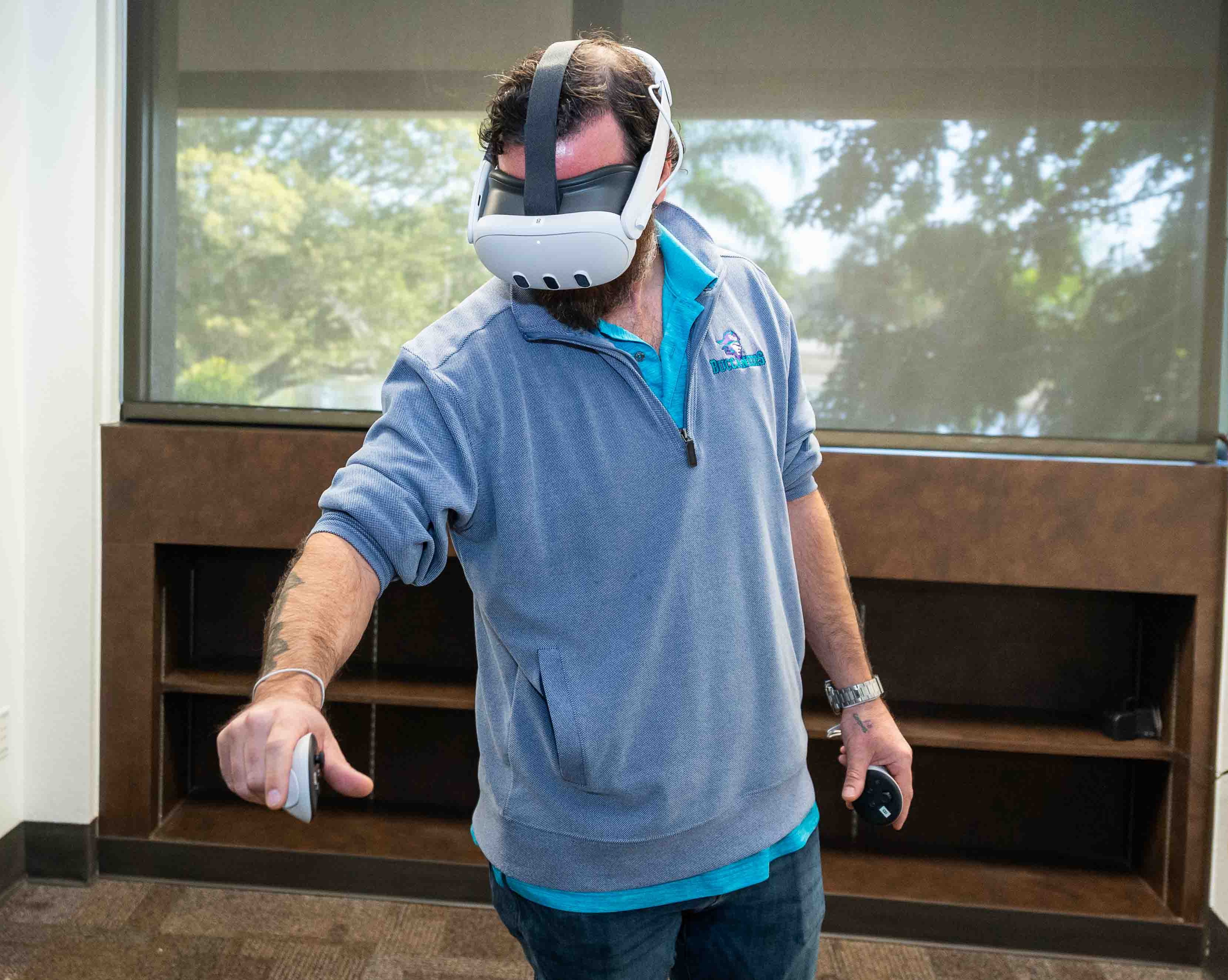
Top Right: Michael Myers, manager of FSW’s Daveler Innovation Center, participates in a hands-on virtual reality simulation during the IIET grand opening.
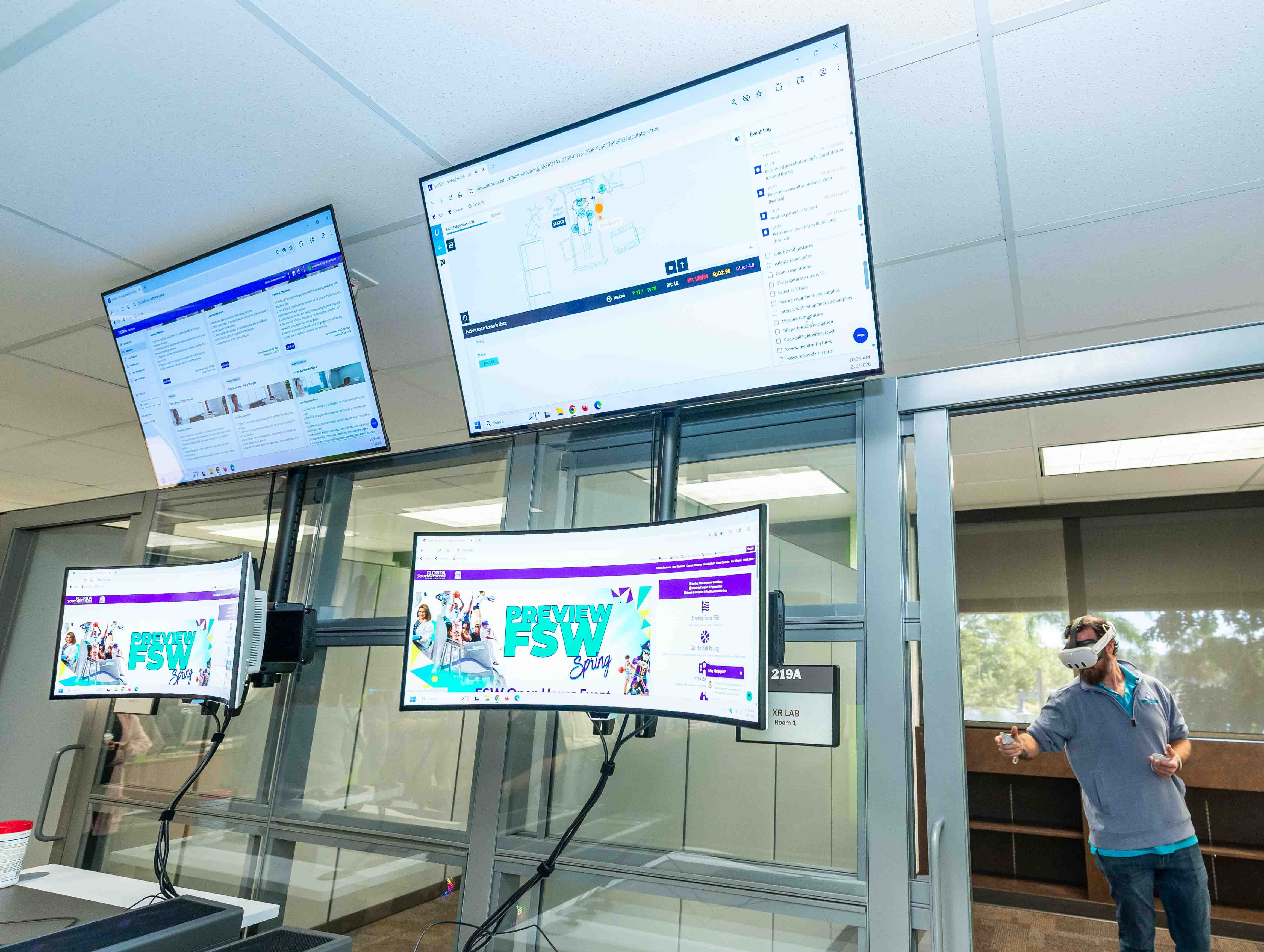
Bottom Left: Overhead monitors provide a live view of the XR simulation, allowing instructors to monitor student progress and performance in real time.
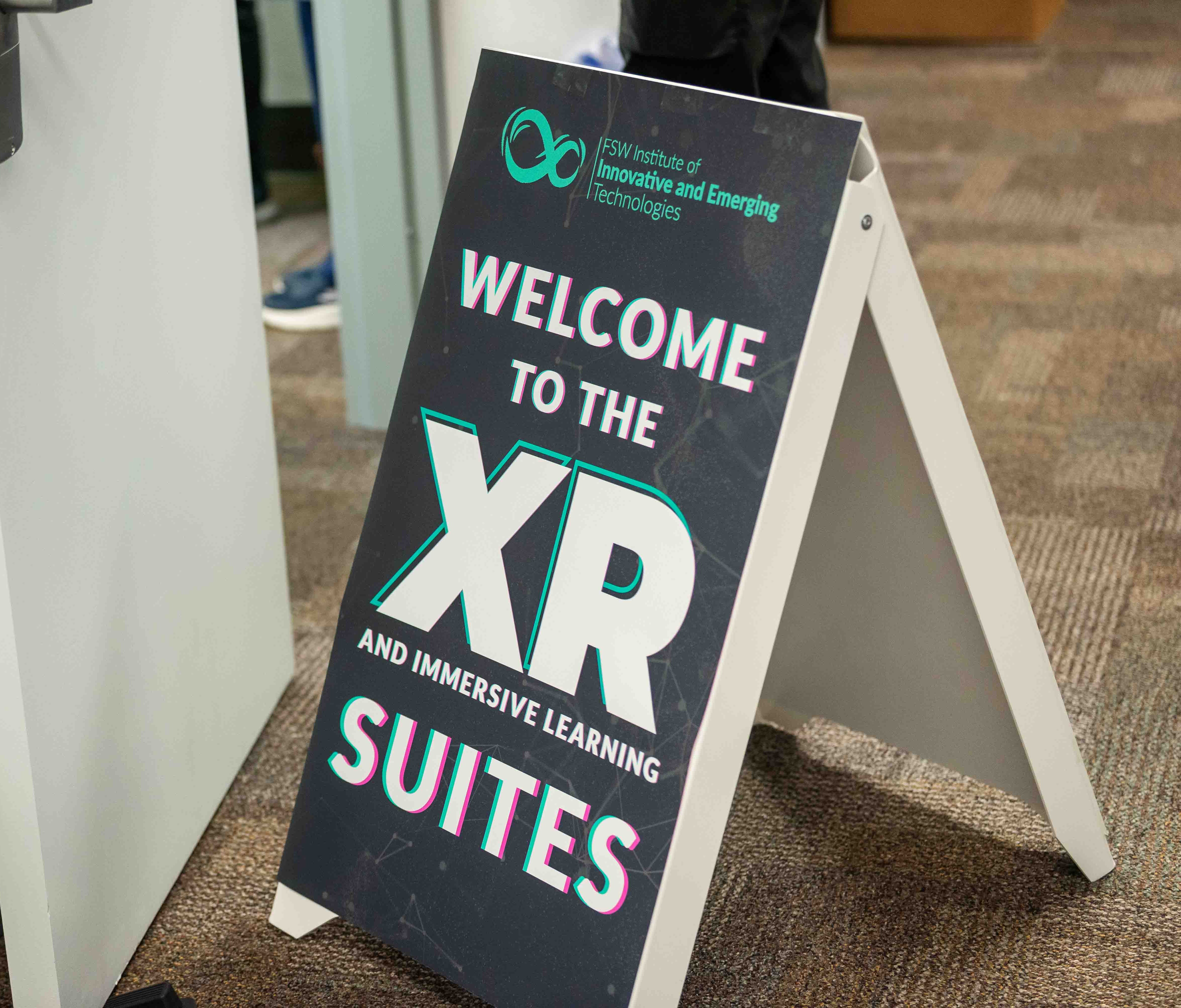
Bottom Right: Signage welcomes guests to FSW’s XR Suites during the grand opening of the IIET.
As healthcare providers increasingly explore immersive technology to strengthen workforce training and staff development, organizations like Lee Health are turning to Florida SouthWestern State College (FSW) to witness the technology in action.
FSW is helping shape the future of healthcare training through its advanced XR Suite, where students engage in immersive, extended reality simulations designed to replicate real-world clinical and nursing scenarios.
“The XR and Immersive Learning initiative at FSW supports students' workplace readiness by giving them a safe practice space for the kinds of skills they'll use in careers,” explained Anna Haney-Withrow, director of FSW’s Institute of Innovative and Emerging Technologies (IIET). “In the lab, we watch them grow in confidence and actively seek new challenges. Essentially, we're seeing durable skills develop along with the specific competencies they're practicing.”
A major advantage of this new learning tool is its interactivity. As students move through the virtual patient care simulation, instructors can monitor each step in real time using an overhead view and a checklist that tracks completed and remaining tasks. Students say the XR experience provides a level of realism that enhances traditional clinical education while helping build confidence before entering healthcare environments. “My experience using the XR lab was out of this world,” said FSW student Youma Midy. “Seeing what it’s like to be in a patient environment, exploring the hospital virtually, and realistically holding equipment and interacting with patients felt incredibly real. It’s such a great add-on for the clinical experience at FSW.” That’s just the kind of thinking that drew leaders from Lee Health for an on campus visit to learn about the technology, where they saw learners fully immersed in patient care situations that respond dynamically to their decisions. “Lee Health has started its own virtual reality journey for new and existing nurses to help maintain standards, increase exposure, and grow skills,” said Jonathan Witenko, system director for digital transformation at Lee Health. “Tools like VR allow us to better prepare our teams in a safe, controlled environment that builds confidence and readiness.” Lee Health’s visit highlighted the growing role immersive technology is playing in healthcare education and workforce development. As hospitals and healthcare systems look for innovative ways to train and retain employees, virtual reality and extended reality technologies are becoming increasingly valuable tools for preparing clinicians in safe, controlled environments. Witenko said experiencing the technology at FSW reinforced the value of hands-on immersive learning and the potential for stronger collaboration between healthcare providers and higher education institutions. “It’s exciting to see this kind of innovation happening locally and to witness firsthand how students gain hands-on, immersive experience, utilizing virtual reality,” Witenko said. By aligning training methods, competencies, and workforce expectations, FSW and Lee Health are helping shape a pipeline of clinicians who are prepared to enter healthcare settings with greater confidence and experience. “As we look at the future of workforce development, immersive technologies like virtual reality are foundational,” Witenko said. “What’s especially powerful is that we’re not building in silos. We’re sharing insights, aligning competencies, and collectively shaping a pipeline of clinicians who are better prepared on day one. That ultimately translates to higher quality care for our community.” FSW leaders say the college’s focus extends beyond teaching technical skills. The goal is also to prepare students to adapt to the evolving technologies they are likely to encounter throughout their careers. “We are preparing students to be comfortable with the kinds of immersive tools workplaces will increasingly use for training, upskilling, and innovation,” Haney-Withrow said. As immersive learning technologies continue to expand, partnerships like the one between FSW and Lee Health are helping prepare future healthcare professionals with the confidence, experience, and technical skills needed to meet the evolving demands of patient care from day one.